Main page › Guides › Rural builds
Building on rural land — what modular makes possible
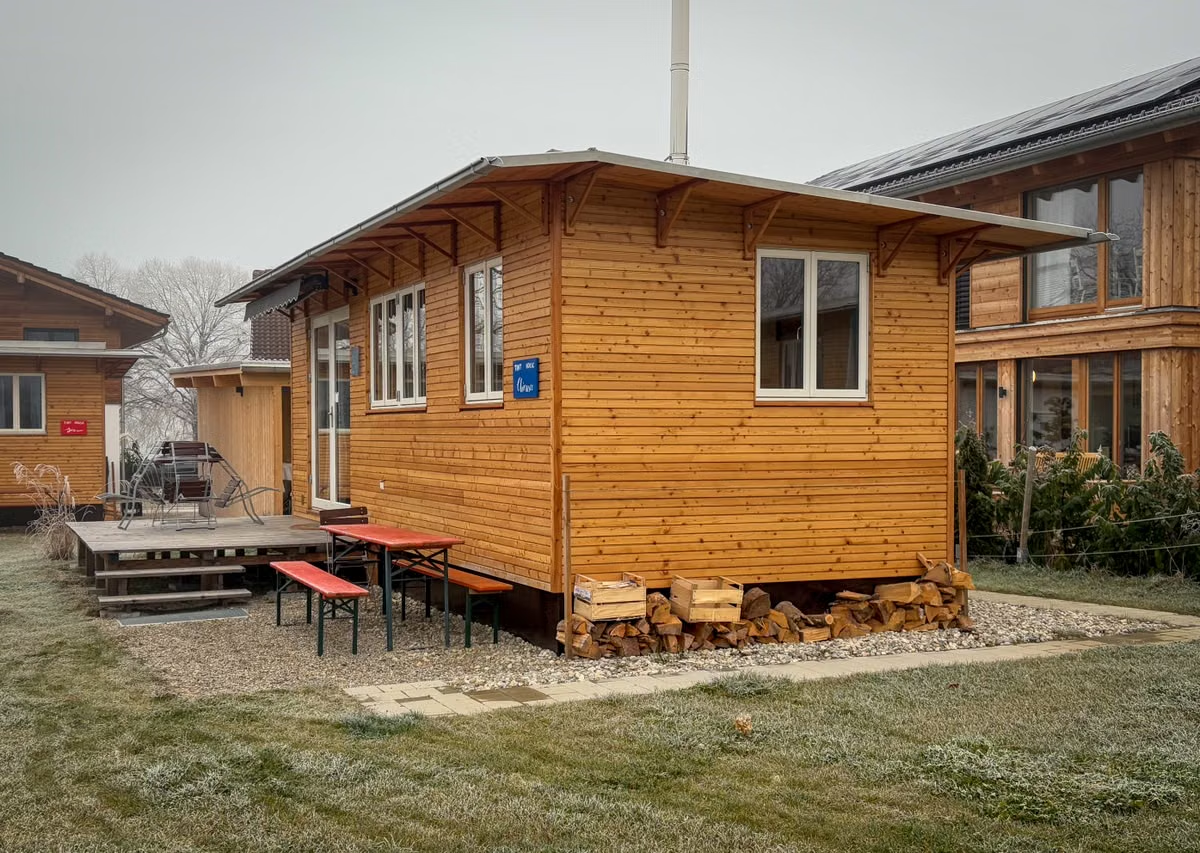 | |
| Illustrative stock image — not a depiction of any specific builder's product. | |
| Core advantage | Far fewer site visits by trades |
|---|---|
| Transport | Sometimes included only within a set radius[1] |
| Crane hire | ≈ A$260–$1,530 per hour[1] |
| Remote or complex lifts | ≈ A$23,000–$30,600 delivery day[1] |
| Factory build window | ≈ 8–14 weeks[2] |
| Additional budget line | Off-grid power, water and wastewater |
Rural and remote blocks are where the case for off-site construction is strongest, and the reason is arithmetic rather than technology. A conventional build requires every trade to travel to the site repeatedly over many months. When the site is two hours from the nearest town, that travel — and the difficulty of scheduling it — often becomes the single largest cost factor in the project.
Off-site construction compresses that problem. Most of the labour happens at a factory where trades are already present, and the block sees a much smaller number of visits.
What the advantage actually is §
- Fewer site visits. The largest saving on remote blocks, and the least visible in a quote.
- Schedule reliability. A factory does not lose a week because the only local plumber is on another job.
- Weather independence. Rain that would stop an exposed rural site does not stop factory production.
- Parallel timelines. Factory manufacturing of roughly 8 to 14 weeks runs while site preparation happens.[2]
The costs that replace them §
Off-site construction does not remove cost so much as relocate it — from labour travel to logistics.
Transport distance
Builders often include transport only within a set radius of the factory, with charges beyond it.[1] On a remote block this can be a significant line item, and it is worth establishing the radius before shortlisting builders — a nearer factory may beat a cheaper distant one.
Road access
The route must physically accommodate an oversize load: sealed or adequately formed surface, sufficient corner radii, adequate bridge and culvert capacity, and clearance from overhanging trees and power lines. A road that a car handles comfortably may not take a truck carrying a module.
Crane positioning
The crane must reach the foundations from stable ground. Published guidance puts crane hire at roughly A$260 to A$1,530 per hour with four to ten hour minimums, and notes that remote or complex lifts can push delivery-day totals to roughly A$23,000 to A$30,600.[1] On rural sites, both the distance and the difficulty tend to sit at the higher end.
Services
Where mains services are unavailable, power, water and wastewater become their own budget line — solar and battery systems, tanks and pumps, and an on-site wastewater system requiring its own approval. This is often the largest cost that has nothing to do with the house itself.
Constraints that still apply §
Modules travel by road, so their dimensions remain bounded by what is legally transportable regardless of how remote the destination is.[3] And all the usual regulation applies: the National Construction Code sets the national baseline, with state and council planning instruments on top.[4] Rural blocks frequently add bushfire attack level assessment, which can materially affect design and cost.
Panelised as an alternative §
Where road access cannot accommodate a volumetric module, panelised construction may still work — flat panels transport more efficiently and can often be handled with smaller equipment. The trade-off is more on-site labour, which partly reintroduces the problem off-site construction was solving. On genuinely difficult access, it can still be the only workable off-site option.
Sequence for a rural project §
- Have someone drive the delivery route and assess it for an oversize load — before design.
- Identify where a crane can stand, and on what ground.
- Establish which services exist and what must be provided independently.
- Check bushfire attack level and any overlays affecting the site.
- Ask builders for their transport radius and the rate beyond it.[1]
- Confirm finance — rural and unserviced blocks can attract additional lender requirements.[3]
Sent to info@modularlivingaustralia.com.au and handled by a person. See Privacy.
References §
- Built by Modify — 2026 modular cost guide — transport and installation sometimes included only within a set radius of the factory; crane hire roughly A$260–$1,530 per hour with four to ten hour minimums; remote or complex lifts pushing delivery-day totals to roughly A$23,000–$30,600. builtbymodify.com.au/blogs/modular-home-cost
- Ecoprestige — 2026 modular construction cost guide — factory manufacturing windows of about 8–14 weeks; module-side critical path of roughly 4–6 months for projects up to 30 modules against 9–14 months traditional. ecoprestige.com.au/modular-construction-costs-australia-price-guide-builders-developers-2026/
- Wright Choice Homes — Modular home overview — modules are transported by road and constrained by road dimensions; lender treatment of modular builds varies between institutions. wrightchoicehomes.com.au/blog/how-much-do-modular-homes-cost/
- Granny Flat Guide — Regulations overview — the National Construction Code sets the national baseline for building work, with state and council planning instruments applying on top. grannyflatguide.com/regulations/
Figures are as published by the sources above at their respective dates and are paraphrased summaries, not verbatim reproductions. Verify current pricing and rules directly with builders, lenders and planning authorities.