Main page › Guides › Modular home finance
Financing a modular home in Australia
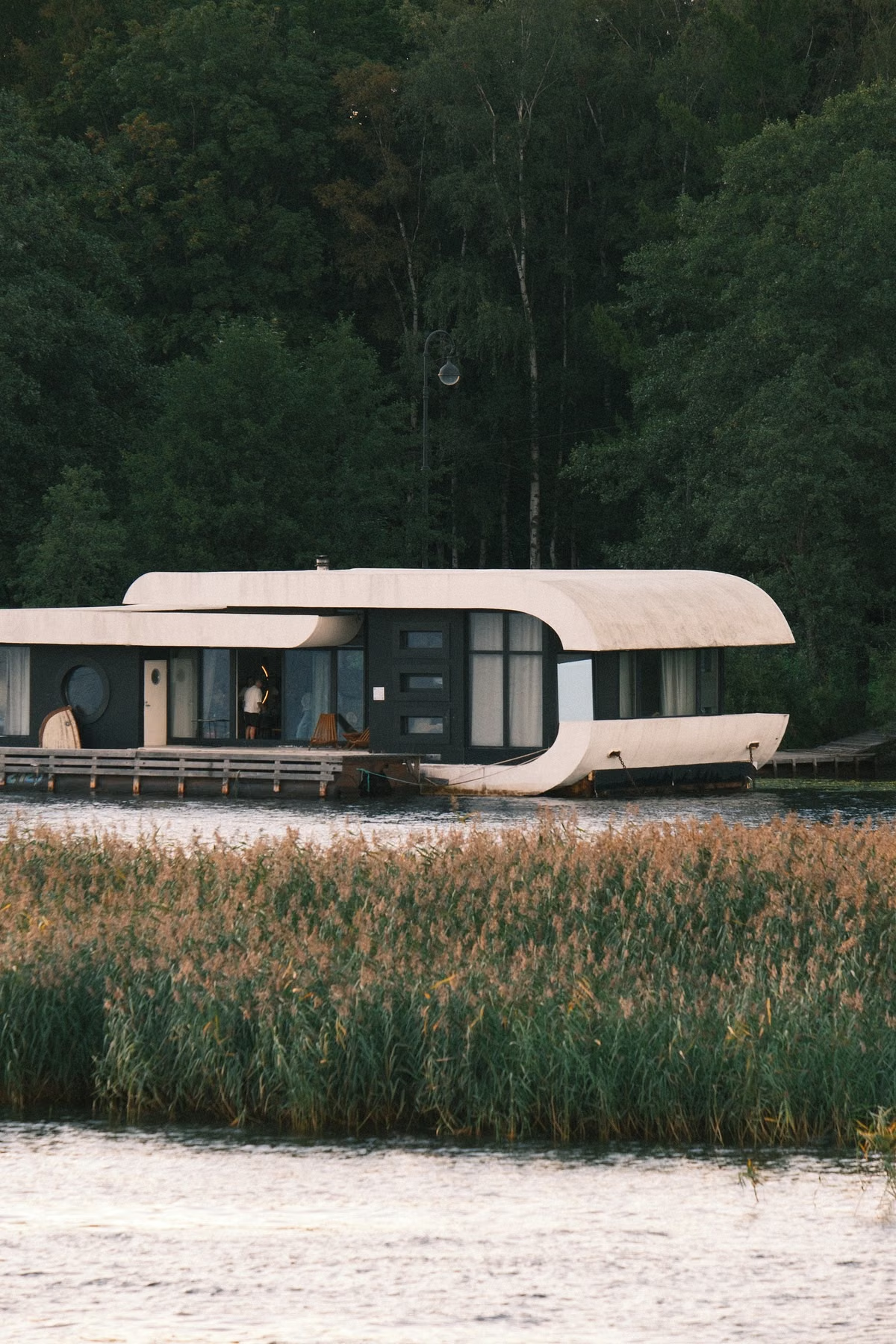 | |
| Illustrative stock image — not a depiction of any specific builder's product. | |
| Core issue | Value is created off-site, before anything appears on your land |
|---|---|
| Standard loans | Release funds against work completed on the land |
| Reported shift | CBA reported in 2025 as first major lender offering drawdowns covering the factory stage[1] |
| Other lenders | NAB, Westpac, Bankwest reported adapting products[1][2] |
| Bankwest (WA) structure | Payment of up to 95% of land value during the off-site phase[2] |
| Tiny homes on wheels | Often financed by personal or vehicle-style lending[3] |
Standard Australian construction loans release money in stages tied to work completed on the land — slab, frame, lock-up, fit-out, completion. A valuer inspects, confirms the stage is reached, and the lender releases the corresponding payment.
Off-site construction breaks that logic. A large share of the value is created inside a factory, on premises the lender has no security over, before anything at all is visible on your block. Resolving that mismatch is the central problem in financing a modular or prefab home, and it is the reason finance should be sorted out before signing a build contract rather than after.
Why it is a problem for lenders §
From the lender's perspective, money paid to a builder for a module sitting in a factory is money advanced against something that is not yet attached to the security property. If the builder fails before delivery, the lender's position is weaker than it would be with a conventional build, where each payment corresponds to work permanently affixed to the land.
This is a genuine risk-management issue rather than institutional reluctance, and it explains why lender responses differ so much.
How Australian lenders have responded §
Published guidance reports that Commonwealth Bank became the first major Australian lender in 2025 to offer construction loans with progressive drawdowns covering the off-site factory build stage, with NAB, Westpac and Bankwest also adapting construction products to modular builds.[1]
Structures differ in the detail. Guidance on Bankwest's Western Australian arrangement describes a payment of up to 95 per cent of land value during the off-site phase.[2] The practical effect of these differences is that the same project can be financeable with one lender and not with another.
| Lender | Reported position | Source |
|---|---|---|
| Commonwealth Bank | Reported as first major lender offering progressive drawdowns covering the off-site build stage (2025) | [1] |
| NAB, Westpac, Bankwest | Reported adapting construction products to modular builds | [1] |
| Bankwest (WA) | Structure allowing payment of up to 95% of land value during the off-site phase | [2] |
What this means practically §
- Finance can determine your shortlist of builders. If your lender will not fund factory-stage payments, builders whose payment schedules are weighted toward the factory become impractical regardless of price or quality.
- Ask for the payment schedule early. Request it from each builder before applying, so the lender can assess the actual structure rather than a generic modular build.
- Ask what protects money paid pre-delivery. Bank guarantees, staged ownership transfer and insurance arrangements vary between builders.
- Ask whether the builder has completed projects with your lender. Precedent smooths the process considerably.
Site costs are financed differently from factory costs §
An off-site project effectively has two cost streams: the factory build, and the site works, transport, crane and connections. The second stream behaves like conventional construction and is usually easier to finance in the normal way. Separating the two in your budget makes the finance conversation clearer, and it also makes builder quotes easier to compare.[4]
Tiny homes are a different category §
A tiny home on wheels is frequently not classed as real property, which puts it outside mortgage lending entirely. Published guidance notes these are often financed through personal or vehicle-style loans instead[3] — typically at higher interest rates and over shorter terms than a mortgage, which materially changes the total cost of ownership even when the purchase price looks low.
A tiny home on a fixed foundation is a different proposition and may be treated as a dwelling. The distinction is worth confirming before assuming a financing route. See Tiny homes.
Questions to take to a broker §
- Which lenders currently fund factory-stage progress payments for residential modular builds?
- What proportion of the contract sum would need to be covered before the module is on my land?
- Does the valuation process differ, and at what points is a valuer involved?
- How are site works, transport and crane costs treated — inside the construction loan or separately?
- What happens if the build is delayed beyond the loan's construction period?
- Are there additional requirements for a home on a rural or unserviced block?
Before you commit §
Resolve finance in principle before signing a build contract. The sequence matters: a signed contract with a payment schedule your lender will not fund is a difficult position to unwind, and deposits are often non-refundable.
A broker with experience in off-site construction is more useful here than a general one, because the relevant knowledge is specific and changes frequently.
Sent to info@modularlivingaustralia.com.au and handled by a person. See Privacy.
References §
- Wright Choice Homes — Modular home finance guide — reports that Commonwealth Bank became the first major Australian lender to offer construction loans with progressive drawdowns covering the off-site factory build stage in 2025, with NAB, Westpac and Bankwest also adapting construction products to modular builds; lender treatment varies between institutions. wrightchoicehomes.com.au/blog/modular-home-finance-guide/
- Shore Financial / Built by Modify — Modular finance guidance — Bankwest structure in Western Australia allowing a payment of up to 95% of land value during the off-site phase; differences between lenders in drawdown timing for factory-stage work. shorefinancial.com.au/how-to-finance-a-modular-home-in-australia/
- Savings.com.au — Tiny homes overview — tiny homes are often financed through personal or vehicle-style loans rather than standard mortgages, because a dwelling on wheels may not be classed as real property. savings.com.au/property/tiny-houses
- Built by Modify — 2026 modular cost guide — payment structures and the separation between factory-stage and site-stage costs; transport and installation sometimes included only within a set radius. builtbymodify.com.au/blogs/modular-home-financing
Figures are as published by the sources above at their respective dates and are paraphrased summaries, not verbatim reproductions. Verify current pricing and rules directly with builders, lenders and planning authorities.