Main page › Guides › Modular home costs
How much does a modular home cost in Australia?
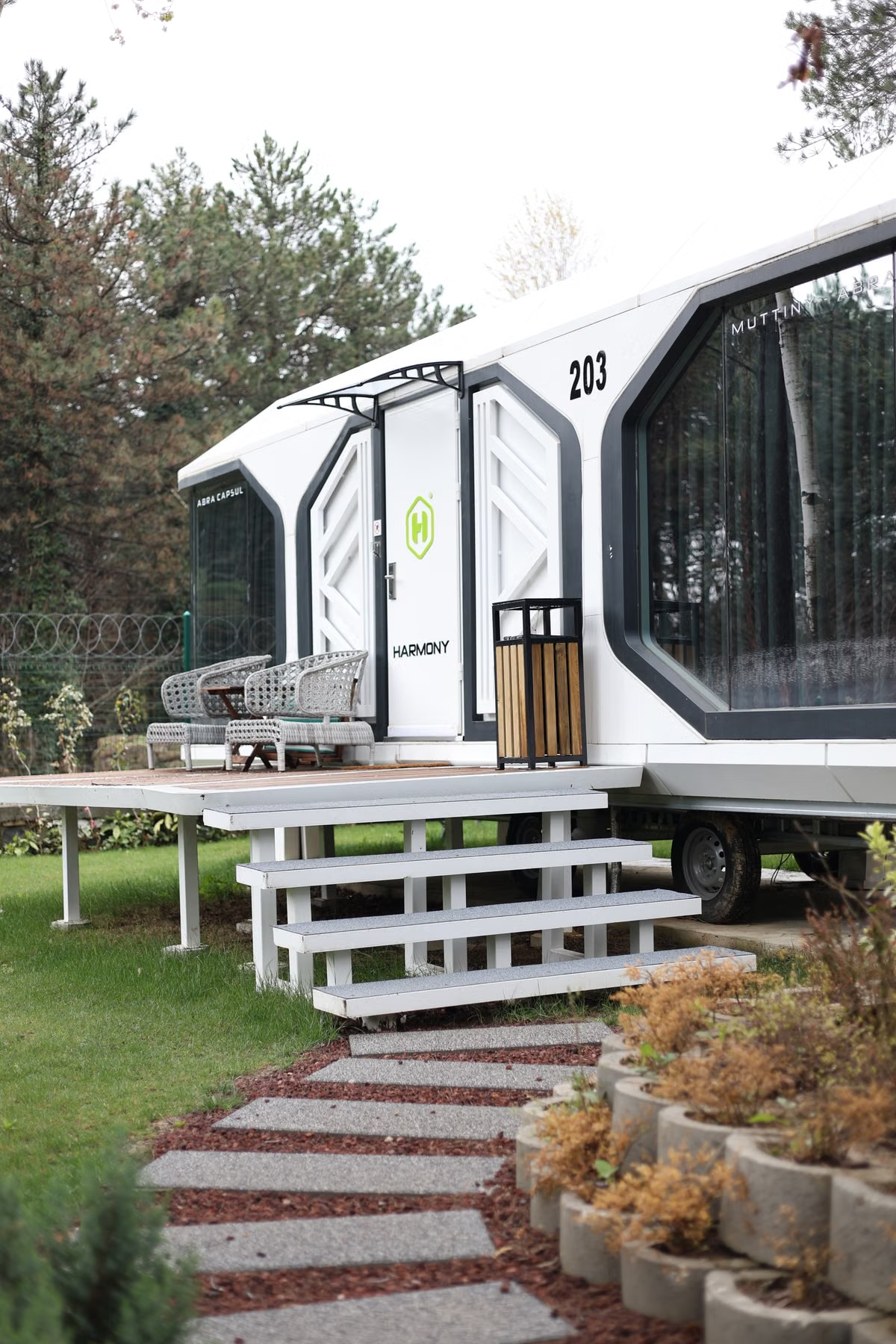 | |
| Illustrative stock image — not a depiction of any specific builder's product. | |
| Small modular home | from ≈ A$300,000[1] |
|---|---|
| Family-sized | from ≈ A$500,000[1] |
| Large / bespoke | A$700,000 – $1 m+[1] |
| Common rate per m² | ≈ A$3,800 – $4,600[2] |
| Lowest advertised rate | from ≈ A$2,300 per m²[2] |
| Crane hire | ≈ A$260 – $1,530 per hour[2] |
| Delivery day, complex sites | ≈ A$23,000 – $30,600[2] |
Published guidance puts a small modular home in Australia from about A$300,000, a family-sized home from about A$500,000, and a large or bespoke design at A$700,000 to over A$1 million, with a common rate of about A$3,800–A$4,600 per m².[1][2] These are builder-published commercial guidance, not independent survey data. The advertised price is rarely the final invoice: delivery, site works and connections can be priced separately, and one guide puts crane hire alone at about A$260–A$1,530 per hour.[2]
The advertised price of a modular home is almost never the amount that appears on the final invoice. Australian builders quote in different ways — some price the module alone, others include delivery and installation within a set radius — and the site-specific work that connects a factory-built module to a block of land can add tens of thousands of dollars.
This guide collects the price guidance Australian builders currently publish, then sets out the cost categories that sit on top of it. Every figure is attributed. None of it substitutes for a written, itemised quote on your own block.
Published base prices §
Anchor Homes' 2026 cost guide gives a three-tier structure that is broadly representative of what Australian modular builders advertise: small prefab homes from about A$300,000, family-sized homes from about A$500,000, and large or bespoke designs between A$700,000 and over A$1 million.[1]
| Category | Published figure | Source |
|---|---|---|
| Modular home — small | from ≈ 300,000 | Anchor Homes[1] |
| Modular home — family-sized | from ≈ 500,000 | Anchor Homes[1] |
| Modular home — large / bespoke | 700,000 – 1,000,000+ | Anchor Homes[1] |
| Compact modular granny flat | from ≈ 107,000 | Built by Modify[2] |
| Granny flat — 1BR (35–40 m²), NSW | 140,000 – 180,000 | Buildana[3] |
| Granny flat — 2BR (50–60 m²), NSW | 180,000 – 260,000 | Buildana[3] |
| Transportable home — base | from ≈ 168,300 | Todd Devine Homes (VIC)[4] |
Rates per square metre §
Per-square-metre rates are useful for comparing designs of different sizes, though they hide as much as they reveal. Built by Modify's 2026 guide puts the common range at approximately A$3,800 to A$4,600 per m², while noting that some builders advertise from about A$2,300 per m².[2] Ecoprestige, writing for developers rather than individual buyers, cites commercial supply rates from about A$2,200 per m².[5]
The gap between the low advertised rates and the common range usually reflects what is included. A A$2,300 per m² figure is more likely to describe a module leaving the factory than a finished home standing on your land.
Costs by state and territory §
Published price guidance varies between states, and not only because building costs do. Builders quote differently in different markets — by bedroom count in Queensland, by whole-home range in Victoria, by square metre in New South Wales — so figures that look comparable often are not. The site-specific work that dominates a final invoice is also local: bushfire and wind classification, soil, slope, and the distance between a factory and a block.
The pages below collect what is published in each jurisdiction, and say plainly where nothing is published.
- New South Wales — two published rate ranges that disagree by roughly a fifth, and what that gap actually measures
- Victoria — whole-home ranges rather than rates, and the exclusion list that decides the total
- Queensland — prices published by bedroom count, and what a fixed-price contract does not fix
- Western Australia — the distance between a factory package price and an installed home
- South Australia — national rates from local manufacturers, and no state-specific installed range
- Tasmania, the ACT and the Northern Territory — Hobart build rates, interstate supply into Canberra, and an absence of Territory data
For secondary dwellings rather than houses, the equivalent material sits under granny flats.
What sits on top of the base price §
The base price typically covers the factory-built structure. The following categories are generally quoted separately, and several are highly site-specific:
- Soil testing and engineering — required before foundations can be designed.
- Site works — clearing, excavation, retaining, and levelling. Slope is the biggest single variable here.
- Foundations — piers or slab, sized to the engineering report.
- Transport — often included only within a set radius of the factory, with a per-kilometre rate beyond it.
- Crane hire — see below.
- Service connections — power, water, sewer or on-site wastewater, telecommunications.
- Approvals — council or private certifier fees, and any specialist reports the site requires.
- External works — decks, stairs, driveway, landscaping, fencing.
Crane and delivery-day costs §
Crane hire is the cost most often underestimated by first-time buyers, because it is invisible until delivery day. Built by Modify puts crane hire at roughly A$260 to A$1,530 per hour, typically with four to ten hour minimums, and notes that remote or complex lifts can push delivery-day totals to roughly A$23,000 to A$30,600.[2]
The variables that drive this are physical: how far the crane must reach, whether it can be positioned close to the foundations, whether overhead power lines require an outage or a longer boom, and whether the access road can carry the truck and the crane at all. These are worth assessing before the design is finalised, not after.
Why quotes are hard to compare §
Because the boundary between "included" and "extra" sits in a different place with every builder, two quotes with similar headline numbers can describe very different deliverables. Built by Modify notes specifically that transport and installation are sometimes included only within a set radius of the factory, which means the same design can cost materially more on a block two hours further out.[2]
The practical response is to ask every builder for the same itemised breakdown, using the categories in the section above, and to compare the exclusions rather than the totals.
Timelines and their effect on cost §
Time is a cost in construction — in interest, in rent paid while waiting, and in exposure to price movement. Ecoprestige's 2026 guide puts factory manufacturing at about 8 to 14 weeks depending on module count and finish, with a module-side critical path of roughly four to six months for projects up to 30 modules, against nine to fourteen months for comparable traditional construction.[5]
Note that these figures come from commercial volumetric projects. An individual home's timeline depends on design, factory scheduling, approval times and site conditions, and the site-preparation work still has to happen in the usual sequence.
Finance affects what you can actually buy §
Standard Australian construction loans release funds against work completed on the land. Off-site construction moves a large share of the value into a factory, before anything is visible on your block, and lender treatment of that mismatch varies between institutions.[6] The practical consequence is that finance can narrow the field of builders available to you, so it is worth resolving before signing a build contract rather than after. See the Finance category.
Before you rely on any of this §
- Most published Australian price guidance comes from builders. Treat it as an orientation range, not a benchmark.
- Site-specific costs — slope, access, soil, distance, services — cannot be estimated generically and often decide the final number.
- Get itemised written quotes with inclusions and exclusions listed, and compare them line by line.
- Confirm what triggers a variation, and who bears the risk if site conditions turn out worse than assumed.
Sent to info@modularlivingaustralia.com.au and handled by a person. See Privacy.
References §
- Anchor Homes — 2026 prefab cost guide — small prefab homes from about A$300,000, family-sized from about A$500,000, large or bespoke designs A$700,000 to over A$1 million. Builder-published commercial guidance. anchorhomes.com.au/blog/how-much-does-a-prefab-home-cost-in-australia-in-2026
- Built by Modify — 2026 modular cost guide — approximately A$3,800–$4,600 per m², with some builders advertising from about A$2,300 per m²; compact modular granny flats from about A$107,000; crane hire roughly A$260–$1,530 per hour with four to ten hour minimums; remote or complex lifts pushing delivery-day totals to roughly A$23,000–$30,600. Builder-published commercial guidance. builtbymodify.com.au/blogs/modular-home-cost
- Buildana — Granny flat rules NSW 2026 — one-bedroom builds of 35–40 m² around A$140,000–$180,000; two-bedroom builds of 50–60 m² around A$180,000–$260,000; premium 60 m² builds to A$300,000. buildana.com.au/insights/granny-flat-rules-nsw-2026
- Todd Devine Homes — Victorian transportable homes price list — base pricing from A$168,300. Builder-published commercial guidance. todddevine.com.au/transportable-homes/
- Ecoprestige — 2026 modular construction cost guide — factory manufacturing windows of about 8–14 weeks; module-side critical path of roughly 4–6 months for projects up to 30 modules, against 9–14 months for comparable traditional construction; commercial supply rates from about A$2,200 per m². ecoprestige.com.au/modular-construction-costs-australia-price-guide-builders-developers-2026/
- Wright Choice Homes — Modular home cost overview — definitions of modular versus tiny homes, and the observation that lender treatment of modular builds varies between institutions. wrightchoicehomes.com.au/blog/how-much-do-modular-homes-cost/
Figures are as published by the sources above at their respective dates and are paraphrased summaries, not verbatim reproductions. Verify current pricing and rules directly with builders, lenders and planning authorities.