Main page › Guides › VIC tiny home rules
Tiny home rules in Victoria
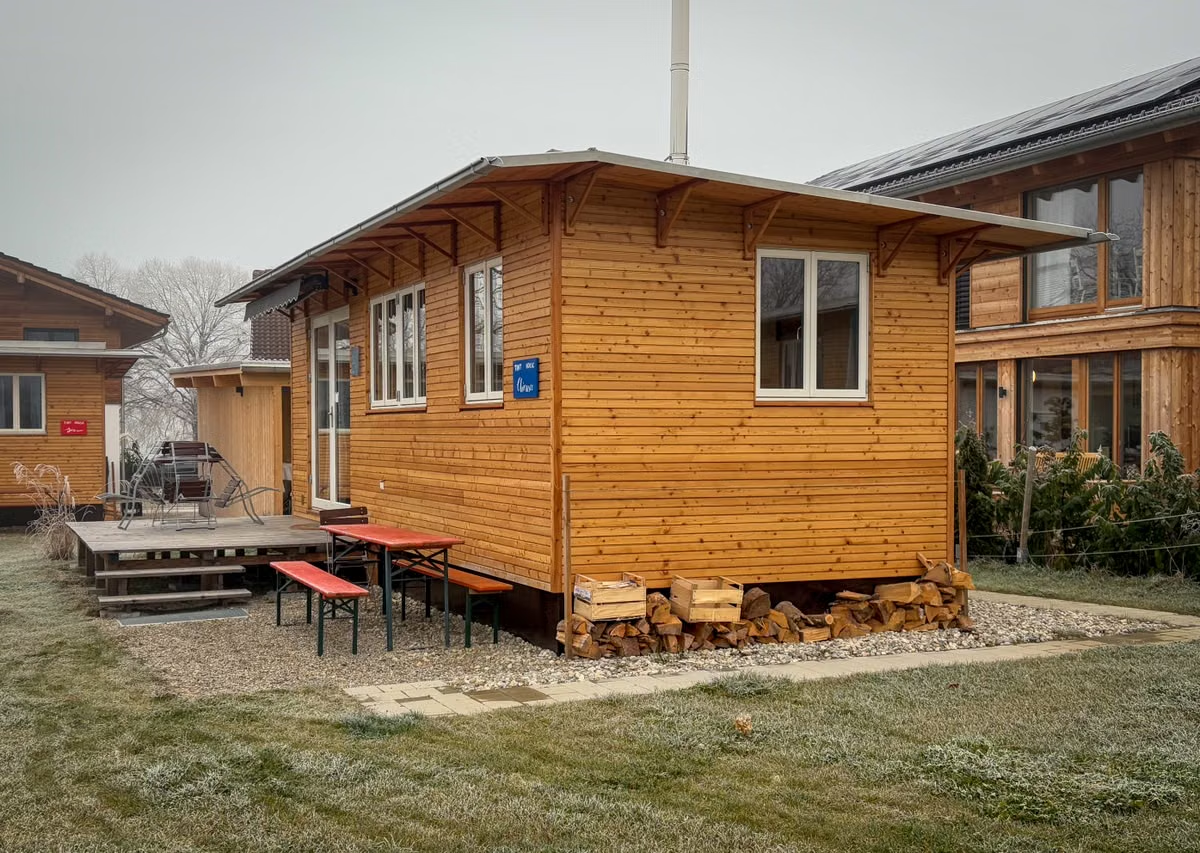 | |
| Illustrative stock image — not a depiction of any specific builder's product. | |
| Fixed dwelling cap | 60 m² floor area[1] |
|---|---|
| Planning permit | Not needed in most cases without flood, environmental or other special controls[2] |
| Lot size | 300 m² or more in most residential zones[1] |
| Gas | Cannot connect to reticulated natural gas[1] |
| On wheels | Set by council local laws; rules differ widely[3][4] |
| Pilot program | Surf Coast Shire, running until December 2026[5] |
Victoria has a clear statewide pathway for fixed tiny homes and no statewide pathway for tiny homes on wheels. A fixed tiny home of up to 60 m² can usually be built without a planning permit as a small second dwelling.[1] A tiny home on wheels is generally treated as camping on private land, under rules each council sets for itself.[6]
Fixed tiny homes — small second dwellings §
A small second dwelling must be 60 m² or less in floor area, sit on a lot with an existing dwelling, and contain its own kitchen sink, food preparation facilities, bath or shower, toilet and wash basin.[1]
No planning permit is needed in the Low Density Residential Zone. In the General Residential, Mixed Use, Neighbourhood Residential, Residential Growth and Township zones, the lot must be at least 300 m², and rural zones have their own conditions.[1] A permit can still be triggered where flooding, environmental or other special planning controls apply.[2]
There are no limits on who may live in a small second dwelling, so it can be rented to an unrelated tenant.[1] It cannot be subdivided or sold separately from the main home.[2] Two things the exemption does not remove: a building permit is always required, and the dwelling cannot be connected to reticulated natural gas.[1]
Tiny homes on wheels §
The Victorian Government has acknowledged that tiny houses often fit none of the existing planning provisions for granny flats or temporary dwellings. In practice they fall under rules for camping on private land, which are restrictive.[6] Those rules sit in each council's local laws, and they differ widely.
Two examples show the range. Mount Alexander Shire allows a caravan or tiny house on wheels to be occupied indefinitely without a permit on land with an existing dwelling, if it can be removed, waste is disposed of off site and the use is private.[3] Hume City Council requires a permit for stays longer than six months, grants permits for up to 12 months at a time, and does not allow camping to be used as a permanent residence.[4] Check your own council's local law before buying.
The Surf Coast pilot
Surf Coast Shire is running a Tiny Houses on Wheels pilot, which the council states will run until December 2026.[5] Whether it is extended or replicated elsewhere is the development worth watching for anyone planning a wheeled dwelling in Victoria.
Road and vehicle rules §
A tiny house on wheels is also a vehicle. VicRoads sets how it is registered and the size limits that apply for road transport.[7] Those dimensions constrain the design as much as any planning rule.
Victoria compared with NSW §
| Victoria | New South Wales | |
|---|---|---|
| Fixed cap | 60 m²[1] | 60 m² for fast-track[8] |
| Lot threshold | 300 m² in most residential zones[1] | 450 m² for fast-track[8] |
| Mechanism | No planning permit needed; building permit still required[1] | Complying development certificate[8] |
| On wheels | Council local laws; varies[3][4] | Statewide household exemption[9] |
What is not covered here §
This page does not cover the local laws of every Victorian council, tiny homes on vacant land, short-term letting, the detailed rural zone conditions for small second dwellings, or the dimensions VicRoads sets for road transport. Where this page gives a council example, it describes that council only. Confirm the position for your block with your council and a registered building surveyor.
Related guides §
- Tiny home rules by state
- Granny flat rules in Victoria
- Tiny house on wheels versus fixed
- Tiny home rules in NSW
Sent to info@modularlivingaustralia.com.au and handled by a person. See Privacy.
References §
- Planning Victoria — Making it easier to build small second dwellings, applicant's guide — Guide dated December 2023. A small second dwelling must be 60 m² or less in floor area on a lot with an existing dwelling, with a kitchen sink, food preparation facilities, a bath or shower, toilet and wash basin. No planning permit is needed in the Low Density Residential Zone, or in the General Residential, Mixed Use, Neighbourhood Residential, Residential Growth and Township zones where the lot is at least 300 m², with separate provisions for rural zones. A small second dwelling cannot be connected to reticulated natural gas, there are no limits on who may occupy it, and a building permit is always required. planning.vic.gov.au/__data/assets/pdf_file/0035/699461/Small-Second-Dwellings_applicants-Guide_v3_FA.pdf
- Victorian Government — Making it easier to build a granny flat — Page updated 20 May 2025. A small second home up to 60 m² does not need a planning permit in most cases where there are no flooding, environmental or other special planning controls; a building permit is still required; and the dwelling cannot be subdivided or sold separately from the main home. vic.gov.au/making-it-easier-build-granny-flat
- Mount Alexander Shire Council — Caravans and tiny houses on wheels on private property, updated 29 June 2023. Under Local Law 13, no permit is needed to occupy a caravan or tiny house on wheels for an indefinite period on land with an existing dwelling, provided it can be removed, wastewater, sewage and refuse are disposed of off site, and it is for private, not commercial, use. Without an existing dwelling, a permit is needed, for a maximum of six consecutive months or 12 months with a building permit. mountalexander.vic.gov.au/Council/Local-laws-permits-and-fines/Local-laws/Caravans-and-tiny-houses-on-wheels-on-private-property
- Hume City Council — Camping or occupying a caravan on private property permits. Under General Local Law No. 1 2023, clause 37, a permit is required to camp on private property with an existing dwelling for longer than six months; a permit is valid for a maximum of 12 months and must then be renewed, and camping is not to be used as a permanent place of residence. hume.vic.gov.au/Residents/City-Laws/Permit-Finder/Camping-or-Occupying-a-Caravan-on-private-property-permits
- Surf Coast Shire Council — Housing projects page. States applications are open for the council's Tiny Houses on Wheels pilot, which will run until December 2026. surfcoast.vic.gov.au/Community/Housing
- Victorian Government — Regulatory Impact Statement for the Residential Tenancies (Caravan Parks and Movable Dwellings Registration and Standards) Regulations 2024. States tiny houses, including those on wheels, often do not fit existing Victorian planning provisions such as granny flat or temporary dwelling provisions, and instead fall under camping on private land, which triggers restrictive regulations. vic.gov.au/sites/default/files/2024-09/Residential-Tenancies-(Caravan-Parks-and-Movable-Dwellings-Registration-and-Standards)-Regulations-2024-Regulatory-Impact-Statemen.pdf
- Australian Tiny House Association — Industry association, state regulations page, 14 November 2023. States that VicRoads specifies the road and vehicle rules governing how a tiny house on wheels is registered and its size limits for transport. tinyhouse.org.au/tiny-house-regulations/state-regulations/
- Wollongong City Council — Granny flats page. Under State Environmental Planning Policy (Housing) 2021, a NSW secondary dwelling can get fast-track approval where it is no more than 60 m² and is on the same property as a single existing home on at least 450 m² of land. wollongong.nsw.gov.au/plan-and-build/building-and-renovating/common-residential-improvements/granny-flats
- NSW Department of Planning, Housing and Infrastructure — Practice note on caravan parks and camping grounds, issued 1 July 2026. The NSW Local Government Regulation allows one caravan or campervan on land with a dwelling house without approval, occupied by the owner of the dwelling house or members of the household. planning.nsw.gov.au/sites/default/files/2026-07/caravan-parks-and-camping-grounds-practice-note.pdf
Figures are as published by the sources above at their respective dates and are paraphrased summaries, not verbatim reproductions. Verify current pricing and rules directly with builders, lenders and planning authorities.