Main page › Guides › Wheels or fixed?
Tiny house on wheels or fixed foundation — which should you choose?
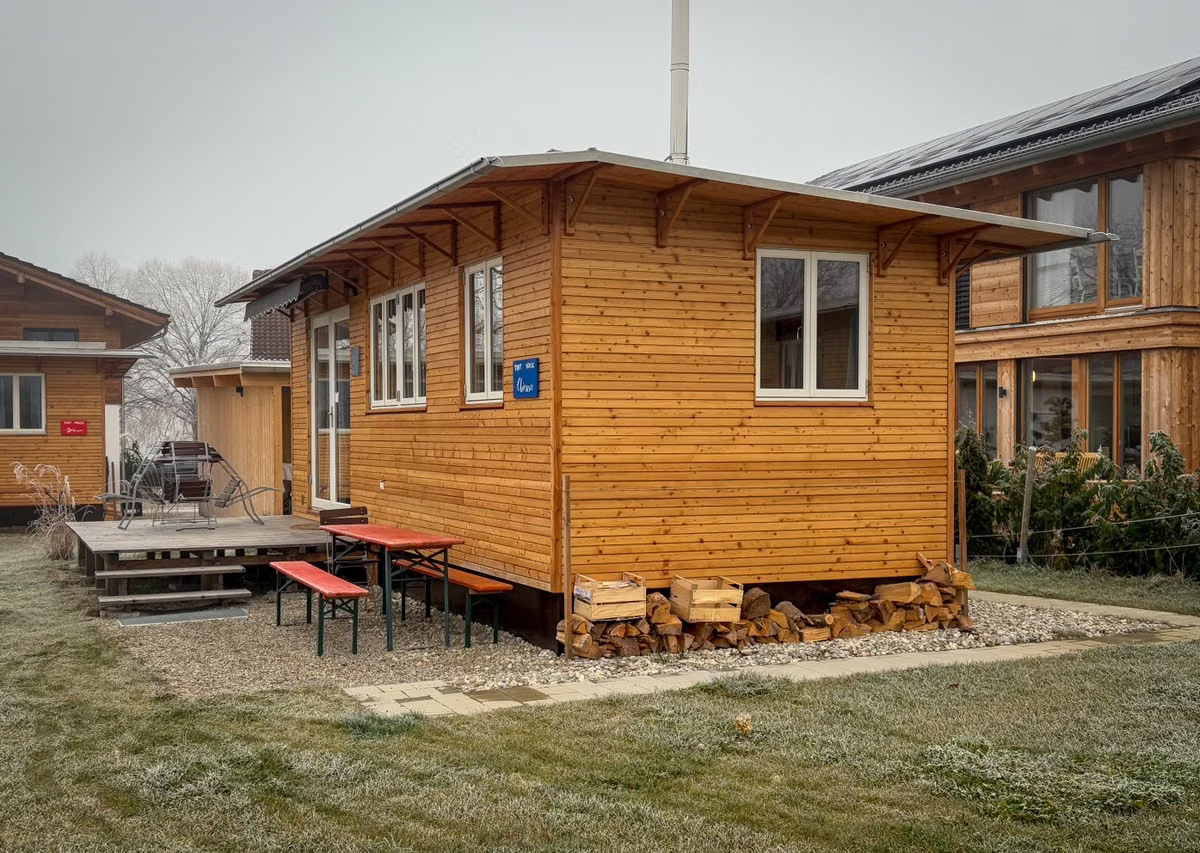 | |
| Illustrative stock image — not a depiction of any specific builder's product. | |
| Fixed — classification | A dwelling, regulated as a building |
|---|---|
| Wheeled — classification | May be a vehicle or caravan[1] |
| Wheeled — road limits | ≈ 4.3 m high, 2.5 m wide, 9 m long[1] |
| Fixed — finance | Can fall within mortgage lending |
| Wheeled — finance | Often personal or vehicle loans[2] |
| Permanent occupation | Far better defined for fixed dwellings |
This is the first decision to make, and most buyers make it last — usually on aesthetic or price grounds. It is worth taking seriously, because it determines which body of law applies to your home.
Two different legal objects §
A tiny house on a fixed foundation is a building. The building code defines how it must be constructed, and planning law governs where it may go.[4]
A tiny house on wheels may be a vehicle. Road rules and vehicle regulations define how it is registered and the size limits that apply for transport.[4] Whether it can be lived in permanently is then a separate question answered by the council.
Side by side §
| On wheels | Fixed foundation | |
|---|---|---|
| Governed by | Road and vehicle regulations[4] | Building code and planning law[4] |
| Size limits | ≈4.3 m high, 2.5 m wide, 9 m long[1] | State size caps for secondary dwellings |
| Approval | Varies widely; often council discretion | Defined pathways in most states |
| Finance | Often personal or vehicle loans[2] | Can fall within mortgage lending |
| Energy compliance | — | BASIX or state equivalent reported[3] |
| Relocatable | Yes | No |
| Adds to property value | Unlikely — usually personal property | Likely — part of the real property |
The plumbing decision §
The boundary between the two is thinner than it looks. Guidance reports that hard-plumbing a mobile dwelling directly into permanent on-site water or sewer networks removes its moveable dwelling status, triggering a Section 68 approval process in NSW.[3]
In other words, connecting your tiny home to the sewer can reclassify it. If mobility is the point, that connection needs to be designed around.
The finance consequence §
Because a dwelling on wheels is frequently not real property, standard mortgage lending may not apply, and buyers often use personal or vehicle-style loans instead.[2] Those typically carry higher rates over shorter terms.
The result is counterintuitive: the cheaper option to buy can be the more expensive one to hold, and it usually does not add to the value of the land it sits on.
Which to choose §
Choose wheels if you genuinely need to move — uncertain tenure, leased land, or a plan that involves relocating within a few years — and you accept the finance and occupation constraints.
Choose fixed if the dwelling will stay put. You get defined approval pathways, better finance options, and value that attaches to the property. On a block that already has a house, a secondary dwelling is usually the better-defined route.
State detail: NSW, Victoria, Queensland.
Sent to info@modularlivingaustralia.com.au and handled by a person. See Privacy.
References §
- Wright Choice Homes — Tiny home definitions — Australian tiny homes typically 15–55 m²; wheeled versions must respect road limits of about 4.3 m height, 2.5 m width and roughly 9 m length to travel without special permits. wrightchoicehomes.com.au/blog/how-much-do-modular-homes-cost/
- Savings.com.au — Tiny homes overview — tiny homes are often financed through personal or vehicle-style loans rather than standard mortgages, because a dwelling on wheels may not be classed as real property. savings.com.au/property/tiny-houses
- Alternative Housing Australia — Tiny home regulations (revised July 2026) — hard-plumbing a mobile dwelling directly into permanent on-site water or sewer networks removes its moveable dwelling status, triggering a Section 68 approval process in NSW; permanent tiny homes on foundations require a BASIX certificate meeting a 7-star NatHERS thermal baseline. alternativehousingaustralia.au/blog/tiny-home-rules-and-regulations-in-queensland/
- Australian Tiny House Association — State regulations — road rules and vehicle regulations define how a tiny house on wheels is registered and the size limitations that apply for road transport; the building code defines how a tiny house on foundations must be constructed. tinyhouse.org.au/tiny-house-regulations/state-regulations/
Figures are as published by the sources above at their respective dates and are paraphrased summaries, not verbatim reproductions. Verify current pricing and rules directly with builders, lenders and planning authorities.